



Before your next account review, ask three questions: what are we counting, are our bidding targets restricting delivery, and how much business did advertising actually add?
Demand Gen’s conversion settings, Google Ads’ new API recommendations and TikTok’s June attribution research each inform a different part of that review. For growth teams, the useful response is to turn the evidence into an account check, a specialist recommendation and a commercially justified decision. Start with the number being reported.
Demand Gen can change the number you optimise towards
A view-through conversion gives an ad credit when someone sees it and later converts without clicking. Google’s Open Beta enables view-through conversion optimisation by default in new Demand Gen campaigns, applying it to video assets across YouTube, Display and Discover.
Eligible impression-attributed conversions enter the main conversions column and influence bidding. Google says this increase may be absent from backend reporting because impression-based metrics are not exported. A stronger Google Ads result therefore needs interpretation before it becomes a claim of business growth. See Google’s Demand Gen VTC guidance.
Check the counting rule before claiming a performance gain
The paid-media specialist should inspect Conversions Optimisation → Include view-through conversions in campaign settings. Then segment the report through Segments → Conversions → Ad event type → Impression.
Check the impression-attributed share of primary conversions. The dedicated VTC column includes biddable and non-biddable actions, so it can show a different total.
Compare the platform report with CRM outcomes using matching conversion definitions and reporting windows. Record the setting and window alongside any performance comparison, particularly if either changed.
Decide whether to retain or disable the setting under the business’s measurement policy, and annotate the report. Reconciliation explains differences between systems; proving additional sales requires causal evidence. Google says this optimisation does not directly focus on incrementality.
Turn Google’s target recommendations into a reporting workflow
Google Ads API v25.2, announced on 23 September, adds Search recommendations to raise target cost per acquisition (tCPA) or lower target return on ad spend (tROAS) when bids restrict auction entry. These give specialists a reason to investigate whether efficiency targets are constraining delivery.
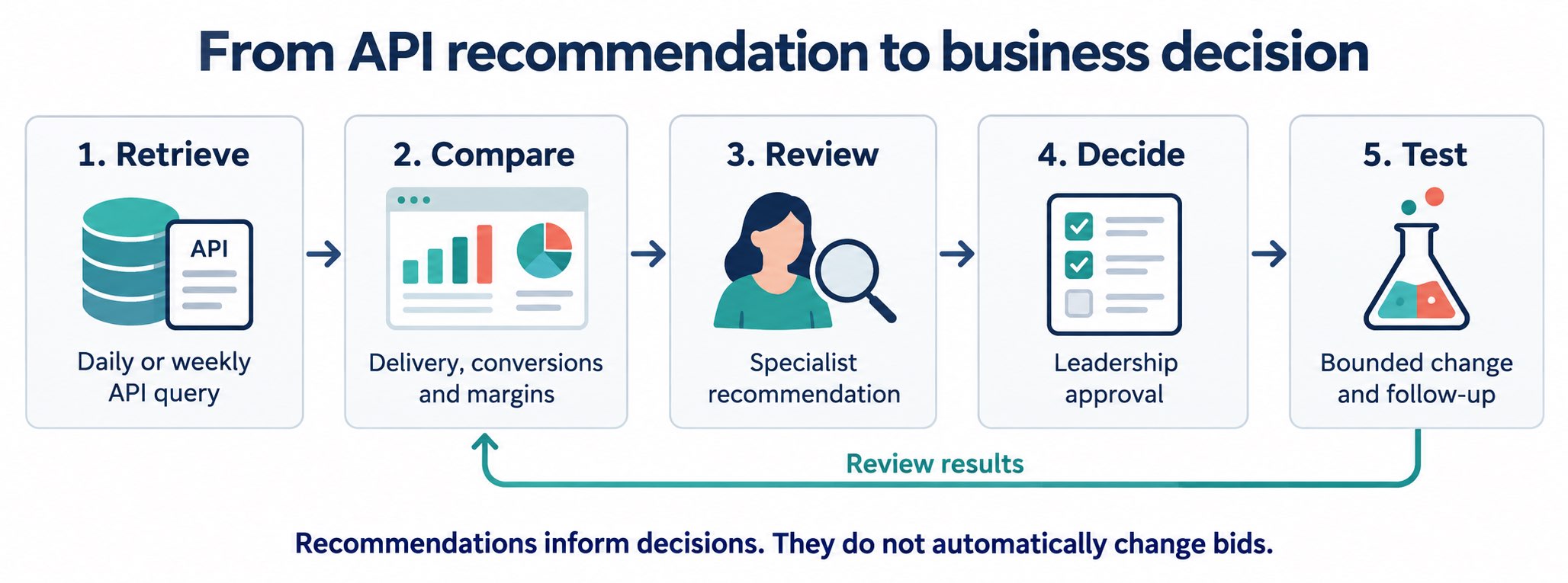
Retrieve, translate and join the evidence
Ask your developer or analytics team to build a daily or weekly retrieval job for the two recommendation types, with validated API access and supported client code. Store timestamped snapshots in a dashboard or an AI briefing’s data source.
Record the recommendation ID/type, account and campaign mapping where available, API average, multiplier and derived suggestion. Track when each recommendation was first and last observed, its change since the previous snapshot and whether retrieval succeeded. A failed fetch must remain distinguishable from a successful query returning no recommendations.
The CPA recommendation fields express the average in account-currency micros: divide by 1,000,000, then apply the multiplier. In a hypothetical AUD account, A$80 × 1.15 suggests A$92. The ROAS recommendation fields use an average and a downward multiplier: 4.0, or 400%, × 0.90 becomes 3.6, or 360%.
Keep those API averages separate from current campaign settings and actual results, retrieved independently. Join delivery, impression share where available, conversions with enough time to mature, CRM lead quality, revenue and margin. Add the business’s approved acquisition-cost or payback limits. AI can summarise this joined evidence and flag missing information for the specialist’s review.
Give leadership a decision, with limits and ownership
Report the suggested change, supporting account evidence, commercial constraint and specialist recommendation. The A$92 suggestion above exceeds a hypothetical A$90 ceiling; that conflict needs an explicit commercial decision.
All inputs below are hypothetical. Illustrative API recommendations need account evidence and commercial approval.
For an authorised test, name the owner, target change, review window and rollback condition. Set the window around conversion lag and account volume; assess delivery alongside business outcomes and commercial limits. A disappearing recommendation alone does not demonstrate improvement.
TikTok’s paper is a reporting idea you can test
June research by TikTok’s Donghui Li and colleagues shows a way to use occasional incrementality experiments to improve everyday attribution reporting. Its main outcome was daily new users, so applying the idea to purchases requires compatible evidence.
“Calibration” means correcting reporting with experiment results. “Cannibalisation” describes the gap when advertising gets credit for outcomes that would have happened anyway, including demand already captured by organic or other channels.
The authors report a roughly 15-percentage-point decline in measured cannibalisation after deployment and subsequent strategy changes. That observation does not isolate the system’s causal impact or promise a sales increase. The useful lesson is to connect daily reporting to experimental evidence.
What you can do in TikTok today
Start in Ads Manager → Analytics → Attribution analytics. Its Performance Comparison report shows how credited conversions vary by attribution window. This helps explain reporting differences; it does not establish how many sales advertising added.
For causal evidence, discuss a Conversion Lift Study with your TikTok representative. It compares exposed and control groups and is a managed service for eligible accounts. Confirm requirements and study scope before planning around it.
Then ask measurement support whether the results justify a separately labelled estimate in external reporting. Hypothetically, 100 attributed purchases and 60 estimated additional purchases imply a provisional 0.60 factor for the compatible tested population, event and window, with uncertainty. This simple example illustrates the principle; reproducing the paper’s daily model requires further analytics work.
Apply the estimate only at the channel, market or product level the experiment supports. Keep platform credit and estimated additional outcomes visible side by side. A campaign-level allocation cannot be treated as proven campaign-level lift without supporting evidence. The paper supplies a modelling approach, rather than a new Ads Manager setting.
Give the next review queue three owners: paid media checks the counting policy; paid search and analytics review auction-entry recommendations; measurement support assesses experimental evidence. Ask each to report the signal, missing information and proposed action. Leadership can then decide commercial exceptions and authorise bounded tests. That creates a repeatable account-review process while keeping platform credit, bidding diagnostics and additional business outcomes clearly labelled.
Sources
- Google’s Demand Gen VTC guidance
https://support.google.com/google-ads/answer/16399666 - Google Ads API v25.2, announced on 23 September
https://ads-developers.googleblog.com/2026/09/announcing-v252-of-google-ads-api.html - CPA recommendation fields
https://developers.google.com/google-ads/api/reference/rpc/v25/Recommendation.RaiseTargetCpaPerformanceBidTooLowRecommendation - ROAS recommendation fields
https://developers.google.com/google-ads/api/reference/rpc/v25/Recommendation.LowerTargetRoasPerformanceBidTooLowRecommendation - June research by TikTok’s Donghui Li and colleagues
https://arxiv.org/abs/2606.26690 - authors report
https://arxiv.org/html/2606.26690v1 - Performance Comparison report
https://ads.tiktok.com/resources/help/article/about-attribution-analytics-performance-comparison?lang=en - Conversion Lift Study
https://ads.tiktok.com/resources/help/article/about-conversion-lift-study?lang=en