SEO is Becoming Retrieval Context Engineering




Table of Contents (Click to show/hide)




SEO used to have a simple starting question:
What does my audience search for?
That question still matters. It is not going away.
But it is no longer enough.
AI search, answer engines, browser agents, and retrieval systems introduce a second question:
What context does a retrieval model need to surface this content accurately?
That is the shift most SEO teams are feeling but have not named clearly yet.
The job is no longer only to publish a page that targets a keyword. The job is to make the page, the brand, the media, the internal links, the schema, and the supporting evidence clear enough for machines to retrieve, summarize, cite, and represent without losing the point.
That does not mean SEO is becoming prompt hacking.
It means SEO is becoming retrieval context engineering.

The Direct Answer
SEO is becoming retrieval context engineering because search visibility is no longer only about matching a page to a keyword. It is also about making the page and the surrounding brand context easy for retrieval systems, AI search engines, and browser agents to understand.
The old SEO question was:
What does my audience search for?
The new SEO question adds:
What context does a retrieval model need to surface my content accurately?
That extra question changes the work.
Keywords still matter because people still use language to search, compare, and decide.
But keywords are becoming the beginning of the brief, not the whole brief.
The strategic layer is shifting from "find a keyword and write a page" to "build a context package that machines can retrieve and humans can trust."
Keywords Are Still Useful, But They Are Not The Whole Brief
It is tempting to turn every SEO shift into a funeral.
Keywords are dead.
Links are dead.
Technical SEO is dead.
Content is dead.
None of that is useful.
Keywords are still useful because they show demand. They reveal how people describe a problem, what language buyers use, which comparisons matter, and where commercial intent starts to appear.
If someone searches AI visibility tracking, semantic SEO, Google AI Overview citations, or llms.txt SEO, that language tells us something real.
The mistake is treating the keyword as the finished strategy.
A keyword can tell you what conversation to enter. It does not automatically tell you what context a retrieval system needs in order to use your page well.
That is where the brief changes.
The old brief might say:
Target keyword: AI SEO
Recommended title: AI SEO Guide For 2026
Word count: 2,000 words
Add FAQ schema.
The retrieval-context brief asks better questions:
- Which entities does an
AI SEOpage need to define clearly? -AI search,SEO,retrieval,AI Overviews,Copilot,ChatGPT,structured data,crawlers - Which related concepts need to be connected so the page is not just a keyword match? -
semantic SEO,technical SEO,entity SEO,crawlability,schema,accessibility,AI visibility measurement - What direct answer should the page give in the first screen? -
AI SEO = content people can use and machines can crawl, understand, retrieve, summarize, and cite - What example would make the idea concrete for a marketer? -
before-and-after AI SEO brief,AI visibility tracking workflow,page audit checklist - What comparison table would help a retrieval system separate similar ideas? -
keyword SEO vs retrieval-context SEO,search crawler vs AI crawler vs browser agent - Which sources should support the claims? - Google AI optimization guide, Chrome Lighthouse agentic browsing, Bing/Copilot docs, Semrush AI visibility docs
- Which internal links give the page a place inside the topic cluster? -
semantic SEO,image SEO,video SEO for AI search,internal-link architecture,technical SEO - Which media and metadata reinforce the meaning? -
retrieval-context map,alt text,image title,caption,<figcaption>,ImageObject,WebPage,BlogPosting - What might an AI system get wrong if this page were retrieved without the surrounding site? -
AI SEO is prompt writing, instead ofcontent structure + crawl access + entity clarity + measurement
That last question is the interesting one.
Most weak SEO content does not fail only because it lacks keywords. It fails because it is vague.
It says things like:
- "AI is changing search."
- "Brands need to create high-quality content."
- "Structured data is important."
- "You should optimize for user intent."
None of those statements are wrong. They are just too generic to carry much retrieval value.
A retrieval-ready page needs sharper context.
Instead of only saying "AI is changing search," explain which part is changing: query fan-out, retrieval-augmented generation, AI summaries, cited sources, browser agents, or AI crawlers.
Instead of only saying "structured data is important," explain which schema types match the visible page: WebPage, BlogPosting, Organization, Person, BreadcrumbList, ImageObject, or VideoObject when a video is actually present.
Instead of only saying "optimize for AI," explain the practical layer: crawl access, direct answers, semantic headings, entity consistency, image captions, source clarity, and measured AI visibility.
That is not abandoning SEO.
It is making the old work more explicit.
Google's own AI optimization guidance still points back to SEO fundamentals: make content crawlable, useful, unique, well-structured, and easy to understand. It also makes clear that there is no special hidden markup that guarantees Google AI visibility.
That is why this article should not become an argument for magic tags.
It should be an argument for better context.
What Retrieval Context Actually Means
Retrieval context is the information a machine needs to understand why a page is relevant, what it is saying, who it is about, which entities it connects, and which part of the page should be used for a specific question.
That sounds abstract, so make it practical.
If an AI search system, vector index, or answer engine encounters one of your pages, it needs to answer questions like:
- What is this page about?
- Who wrote it?
- What brand, person, product, service, category, and topic does it involve?
- What problem does the page solve?
- What is the direct answer?
- What section answers which subquestion?
- What sources support the claims?
- What media helps explain the idea?
- What related pages on the same site add context?
- Is the page current, crawlable, and internally consistent?
Classic SEO already cared about some of this.
Title tags helped describe the page.
Headings helped structure the page.
Internal links helped connect related content.
Schema helped clarify entities.
Alt text helped describe images.
The difference is that AI search makes the cost of ambiguity higher.
When a page is vague, the old result might still rank and get a click if the title was attractive enough.
In an AI-shaped result, the system may summarize the vague version of your argument, skip the page, cite someone clearer, or represent your brand in a way that misses the commercial point.
That is why retrieval context is not only a writing issue.
It is a system issue.
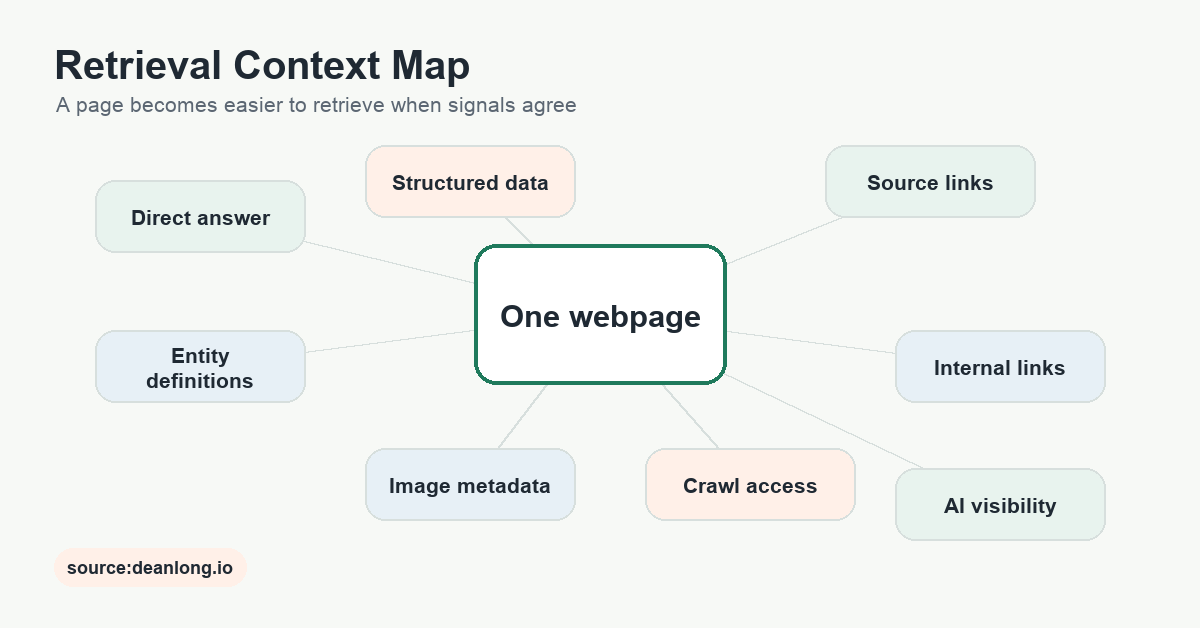
A strong page gives machines multiple aligned signals:
This is why I like the phrase retrieval context engineering.
It forces SEO out of the shallow keyword mindset without pretending the old fundamentals disappeared.
The job is still to help users find useful answers.
But now the answer has to survive more machine interpretation before the user ever sees it.
Context Blocks: The New Content Strategy Unit
If the old content unit was the keyword page, the new content unit is the context block.
A context block is a section of a page that answers one retrievable subquestion clearly enough to make sense on its own.
It does not need to be long.
It does need to be complete.
For example, a weak section might say:
AI visibility is important because more users are using AI tools to search.
That is true, but thin.
A stronger context block would answer:
- What does AI visibility mean?
- Which systems are we talking about?
- How is it different from rankings?
- What can a marketer measure?
- What should they not overclaim?
That turns the section into something a retrieval system can use.
Useful context blocks include:
This also changes how briefs should be written.
A normal content brief might include:
- Target keyword.
- Secondary keywords.
- Search intent.
- Competitor pages.
- Suggested headings.
- Word count.
A retrieval-context brief should still include those things, but it should add:
- Primary entities.
- Supporting entities.
- Definitions required.
- Questions the page must answer directly.
- Claims that need sources.
- Internal links and anchor text.
- Media required and metadata for each image.
- Schema types that match visible content.
- Crawl/accessibility checks.
- AI visibility checks after publishing.
That does not make the content process heavier for the sake of it.
It makes the implicit work visible.
Good SEOs have always cared about clarity, structure, links, and evidence. The difference is that AI search punishes mushy context faster because it has to decide which chunks, entities, and sources are worth using.
This is also where internal links become more important, not less.
An isolated page has to explain everything by itself.
A page inside a strong content web can borrow context from nearby pages: semantic SEO, image SEO, video SEO, AI search, technical SEO, paid media automation, analytics, and measurement.
That is why internal linking is not only a user journey tactic anymore.
It is retrieval context.
When a page links to related articles with descriptive anchors, it helps both readers and machines understand where the page belongs.
For this topic, that means the retrieval-context argument should connect naturally to related pages on semantic SEO, image SEO, video SEO for AI search, internal-link architecture, and the broader idea that automation moves control upstream.
The article should not try to say everything in one section.
It should make the next layer obvious.
Vector Index Hygiene Is The Technical Version Of Good Editorial Structure
Vector index hygiene sounds like a data engineering problem.
Sometimes it is.
But for most SEO teams, the practical lesson is simpler:
If your content would be confusing when broken into smaller sections, it will probably be confusing when retrieved by a system that works with chunks, embeddings, passages, or source snippets.
That does not mean Google organic search works exactly like your internal vector database. It does not mean we should pretend to know the full retrieval architecture behind every AI answer engine.
But vector search gives marketers a useful mental model.
In vector search, content is represented in a way that lets systems retrieve semantically similar information. The system is not only looking for the exact keyword. It is trying to find meaning, proximity, relationships, and relevance.
That makes vague content expensive.
A weak section says:
AI SEO helps brands become more visible in AI search.
A stronger section says:
AI SEO helps a page become easier for search and AI systems to crawl, parse, retrieve, summarize, and cite by improving direct answers, entity clarity, semantic HTML, structured data, internal links, image context, and source-backed claims.
The second version is not longer just for the sake of length.
It gives the system more handles.
It names the task.
It names the systems.
It names the mechanisms.
It names the practical work.
That is the editorial side of vector index hygiene.

This is where SEO and content quality meet technical discipline.
If a page has five vague sections, generic headings, no source links, no internal links, and images with thin alt text, the issue is not only editorial taste.
It is retrieval weakness.
The page gives machines less stable context to work with.
The fix is not to stuff more keywords into the copy.
The fix is to make each section easier to identify, understand, extract, and connect.
Structured Data Expansion Beyond Standard Schema Templates
Structured data is another place where AI-era SEO needs more nuance.
Schema is useful because it gives search systems explicit clues about what a page contains.
But schema is not magic.
It does not guarantee rankings.
It does not guarantee AI citations.
It does not let you declare expertise that is not visible on the page.
Google's AI optimization guidance is clear on the important guardrail: there is no special schema.org markup that makes a page eligible for Google AI features. Traditional SEO fundamentals still matter.
That does not make structured data irrelevant.
It means structured data should be treated as alignment infrastructure.
The visible page, HTML, schema, media, internal links, and source links should all tell the same story.
For a serious article, the baseline graph might include:
The key is honesty.
If the page has no visible FAQ, do not add FAQ schema just because it feels useful.
If the page embeds a YouTube video on your own website, you can add VideoObject schema to your owned page. You cannot add your own schema to the YouTube watch page itself.
Always check the official Schema.org page for the schema type you are using, then add as many accurate and relevant properties as you can support with the visible page. The goal is not to keep schema minimal. The goal is to make the page's real meaning, relationships, media, author, publisher, dates, and entity context as explicit as possible without inventing anything.
If the image is meaningful, support it properly: descriptive alt, image title where the CMS supports it, caption, <figure>, <figcaption>, nearby explanatory copy, and ImageObject where appropriate.
For DEANLONG.io images, the production rule is simple: ALT text, image title, and image caption should end with source:deanlong.io.
That sounds small, but it is the kind of consistent metadata practice that makes media context cleaner over time.
Structured data expansion is not about adding every schema type you can find.
It is about making the machine-readable layer match the human-readable page.
Crawl Accessibility For AI Search Crawlers And Browser Agents
There are three different access problems that often get mushed together.
They should be separated.
This is where technical SEO expands.
The old crawlability checklist still matters:
- Is the page indexable?
- Is it blocked by robots.txt?
- Is the canonical correct?
- Can Google render the important content?
- Are internal links crawlable?
- Are JS and CSS resources available when they are needed for rendering?
- Does the page return the right status code?
But AI search and agentic browsing add more practical questions:
- Can an AI search crawler access the content you want surfaced?
- Have you made deliberate robots.txt decisions for crawlers such as Googlebot, Bingbot, OAI-SearchBot, GPTBot, and other AI-related agents?
- Is the important content visible in HTML after rendering, not trapped in an inaccessible interface?
- Do headings explain the page structure?
- Do forms have labels?
- Are buttons real buttons, not clickable divs?
- Do navigation, main content, articles, sections, asides, and footer areas use semantic tags where appropriate?
- Do images have useful alt text, titles, captions,
<figure>, and<figcaption>? - Does ARIA clarify the interface where native HTML is not enough?
The ARIA point matters.
ARIA can help agents and assistive technologies understand names, states, and relationships. Useful attributes include aria-label, aria-labelledby, aria-describedby, aria-expanded, and aria-controls.
But ARIA should not be used to paper over broken HTML.
A native <button> is better than a clickable <div> with a role patched on later.
If the action is navigation, use an <a> link with a real href. If a link is styled visually like a button, the <a> can wrap the button-style content, but the semantics should still be a link. Give important links a clear title where useful, and use rel attributes when the relationship matters, such as rel="noopener" or rel="nofollow sponsored" where appropriate.
A real <label> attached to a form field is better than placeholder text pretending to be a label.
A logical <article> or <main> element is better than a page made of anonymous containers.
This is not only accessibility work.
It is machine readability work.
If a browser agent has to interact with a page, it needs to understand what the controls are, what state they are in, and what action they perform.
The same applies to images.
A generic image file called image-1.png with alt text like "diagram" does not help much.
A better image package includes:
- Descriptive file name.
- Descriptive
alt. - Image title where supported.
- Caption.
<figure>and<figcaption>.- Surrounding paragraph that explains why the image matters.
ImageObjectschema where appropriate.

That is the difference between image decoration and image context.
The llms.txt Contradiction
There is also a useful contradiction worth calling out.
Google's AI optimization guidance says there is no special AI markup required for Google AI visibility. In plain English, you should not treat llms.txt as a requirement for Google AI Overviews, AI Mode, or Google Search visibility.
At the same time, Chrome's experimental Lighthouse agentic browsing scoring includes llms.txt as one of its agent-readiness signals.
Both things can be true.
The practical interpretation is:
- Do not sell
llms.txtas a Google ranking factor. - Do not say
llms.txtis required for Google AI visibility. - Do test
llms.txtas experimental agent-facing documentation. - Do use Chrome Canary or Lighthouse agentic browsing checks as readiness signals, not as final proof of AI visibility.
That is the kind of nuance AI SEO needs.
Some work matters because Google has documented it for Search.
Some work matters because browser agents and AI tools may use it as a navigation or context aid.
Those are related, but they are not the same claim.
Brand Recommendations Depend On Relationships, Not Just Pages
Retrieval context is not only about whether a single page can be found.
It is also about how the brand is understood.
This is where relational knowledge and topical presence become useful ideas.
An AI system does not only need to know that a page exists. It needs to understand relationships:
- Brand to category.
- Brand to service.
- Brand to audience.
- Brand to location.
- Brand to use case.
- Brand to proof.
- Author to expertise.
- Content to adjacent topics.
For example, a brand might publish ten articles about AI SEO and still be weakly associated with technical SEO if those articles never connect the brand to crawlability, schema, rendered HTML, AI crawlers, accessibility, source citations, and measurement.
That is a relationship problem.
Publishing more content will not automatically fix it.
The brand needs clearer associations.
Practical work includes:
- Use consistent brand, author, and service names across the site.
- Make the About page specific, not fluffy.
- Connect author bios to real expertise and topics.
- Use
Organization,Person,WebSite,WebPage, andsameAsaccurately. - Link commercial pages, case studies, blog posts, YouTube content, LinkedIn, and third-party profiles with consistent language.
- Publish examples, screenshots, case studies, tools, and opinionated analysis that make the brand's expertise visible.
- Update external profiles and listings so they describe the brand in the same category language.
This is where the paid media automation analogy is useful.
Automation does not remove control. It moves control upstream.
AI search does something similar.
You may not control how every model represents your brand, but you can improve the public evidence, entity clarity, content structure, and associations those systems may retrieve or learn from.
That is not perfect control.
It is better input discipline.
Retrieval Layer, Knowledge Graph Layer, Context Graph Layer
One reason AI visibility conversations get messy is that people treat the problem as one thing.
It is not one thing.
In Search Engine Journal, Duane Forrester argues that AI visibility has three different layers, each with different failure modes, fixes, and owners.
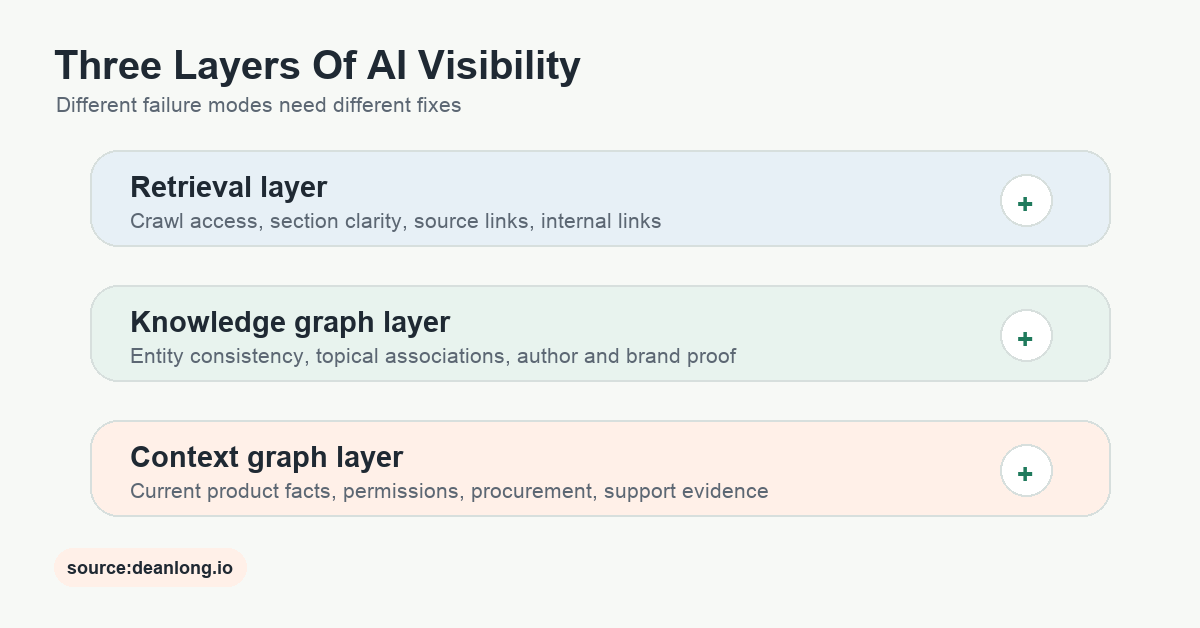
The distinction matters because each layer has a different fix.
If the retrieval layer is broken, publishing another thought leadership piece may not help. You may need crawl access, clearer headings, better source sections, or content that can actually be rendered and indexed.
If the relationship layer is broken, adding more keywords may not help. You may need stronger entity consistency, author signals, sameAs links, case studies, and third-party proof.
If the context graph layer is broken, another blog post may not help. You may need cleaner product documentation, support pages, pricing pages, implementation guides, procurement content, and partner-facing evidence.
A knowledge graph models what things are and how they relate generally.
A context graph is more operational. It cares about what is current, valid, permitted, authorized, and useful inside a specific environment.
Most SEO teams can directly influence the retrieval layer and the public entity layer.
They usually cannot directly edit a customer's internal context graph.
But they can influence what gets ingested into those systems by making public and partner-facing evidence clearer, more consistent, and easier to trust.
That is a different kind of SEO work.
It is less about one perfect blog post.
It is more about the evidence architecture around the brand.
The New Ownership Map
This shift cannot sit with one person forever.
The content strategist can improve the brief.
The technical SEO can improve crawl access and structured data.
The analytics person can track the signals.
The brand or partnerships person can improve external proof.
But retrieval-context SEO only works when those jobs connect.
This is why I do not like treating AI visibility as a side project.
If nobody owns the prompt checks, nobody notices misrepresentation.
If nobody owns crawl access, useful pages may never become retrievable.
If nobody owns entity consistency, the brand stays fuzzy.
If nobody owns evidence architecture, enterprise agents may ingest whatever stale PDF, old partner profile, or vague review happens to be available.
The point is not to create a brand-new department on day one.
The point is to name the work before the reporting conversation starts.
Practical AI Visibility Actions To Start With
This does not need to begin as a massive transformation project.
Start with a simple measurement and testing layer.
The goal is to find out whether AI systems can access your content, whether they cite or mention you, whether they describe you correctly, and whether competitors are being represented more clearly.
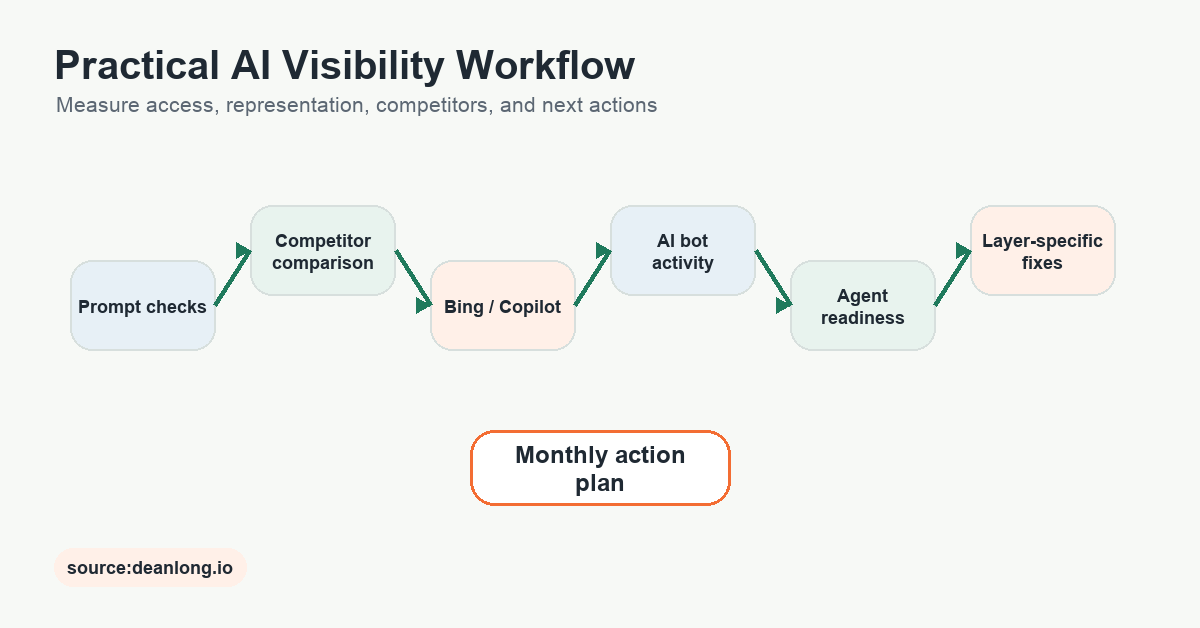
A simple monthly workflow could look like this:
- Pick 20 prompts that matter commercially.
- Run them across Semrush, ChatGPT, Gemini, Copilot/Bing, Perplexity, and Google AI features where available.
- Record whether your brand appears, which competitors appear, and which sources are cited.
- Check Bing Webmaster Tools for AI/Copilot reporting where available.
- Check Clarity for AI bot activity and requested paths.
- Run Lighthouse agentic browsing checks on the homepage, one service page, one article page, and the contact form.
- Turn each issue into a layer-specific fix.
That last point matters.
Do not treat every AI visibility problem as a content-volume problem.
The point of measurement is not to create another dashboard nobody uses.
It is to decide which layer needs work.
A 90-Day Retrieval Context Upgrade Plan
If I had to turn this into a practical plan, I would not start by rewriting the whole site.
I would pick one commercial topic cluster and make it genuinely clear.
First 30 Days: Audit
Choose one topic where AI visibility matters commercially.
For example:
- AI SEO consulting.
- Google Ads automation.
- Value-based bidding.
- Technical SEO.
- Video SEO for AI search.
Then audit the pages around that topic.
Check:
- Which page is the primary page?
- Which supporting articles exist?
- Which entities should be associated with the topic?
- Which pages define those entities clearly?
- Which pages have direct answers?
- Which pages have vague headings?
- Which pages have source-backed claims?
- Which pages have structured data that matches visible content?
- Which images have useful alt text, title, caption, and
<figcaption>? - Which pages are indexable and renderable?
- Which internal links are missing?
- Which AI prompts include or exclude the brand?
By the end of the first 30 days, the output should be a map, not a pile of opinions.
You should know which layer is weakest:
- Retrieval.
- Entity/relationship clarity.
- Technical access.
- Media metadata.
- External evidence.
- Measurement.
Days 31-60: Rebuild
This is the month to fix the obvious gaps.
Do not start with the most complicated thing.
Start with clarity.
Useful rebuild actions:
- Add direct-answer blocks near the top of priority pages.
- Rewrite vague H2s and H3s.
- Add entity definitions where the page assumes too much.
- Add comparison tables where concepts blur together.
- Add examples, formulas, workflows, or screenshots.
- Add source links to claims that need support.
- Add internal links with descriptive anchors.
- Expand schema accurately using official Schema.org properties.
- Improve image file names, alt text, titles, captions,
<figure>, and<figcaption>. - Test
llms.txtas an experimental agent-facing file, but do not treat it as a Google requirement. - Update About, author, service, case study, and proof pages so the brand/entity story is consistent.
This is also where you should decide whether thin overlapping pages need to be merged.
If five pages are all trying to rank for slightly different versions of the same idea, but none of them gives a strong answer, the problem is not that you need a sixth page.
The problem is weak architecture.
Days 61-90: Measure
Now rerun the checks.
Compare:
- GSC query movement.
- Indexed page status.
- Bing/Copilot visibility where available.
- Semrush AI visibility trend snapshots.
- Clarity AI bot activity.
- Manual prompt outputs.
- AI answer citations.
- Brand descriptions.
- Competitor inclusion.
- Consultation clicks or commercial page clicks.
- CRM or pipeline notes where available.
The question is not only "did traffic go up?"
The better questions are:
- Are we being retrieved for the right topics?
- Are we being described accurately?
- Are competitors being cited from stronger sources?
- Are AI systems using old or weak evidence?
- Are our internal links helping the cluster make sense?
- Are our commercial pages receiving better supporting traffic?
That is a better reporting rhythm.
It connects visibility, retrieval, representation, and business outcomes.
My Take
SEO is not becoming prompt hacking.
It is becoming context discipline.
The useful work still looks familiar:
- Helpful content.
- Clear headings.
- Crawlable pages.
- Internal links.
- Schema.
- Image metadata.
- Source links.
- Author and brand clarity.
- Measurement.
The difference is that the audience now includes retrieval systems, AI search interfaces, and browser agents.
That changes the standard.
A page cannot only be readable.
It has to be retrievable.
It has to be segmentable.
It has to be entity-clear.
It has to be supported by evidence.
It has to be technically accessible.
And it has to sit inside a wider web of content that helps machines and people understand what the brand actually knows.
The teams that win will not be the ones that chase every new acronym.
They will be the ones that make their expertise easier to find, parse, trust, retrieve, and represent.
That is retrieval context engineering.
Need A Second Pair Of Eyes On Your AI Search Visibility?
If your team is trying to understand how SEO, AI visibility, structured data, content architecture, and analytics should fit together, I can help turn the noise into an action plan.
I work across SEO, paid media, analytics, content systems, and technical implementation, which is usually where these problems actually live.
Get in touch through DEANLONG.io if you want a practical review of your content cluster, AI visibility signals, schema, internal links, or measurement setup.
Sources
- Google Search Central: AI optimization guide
- Google Search Central: AI features and your website
- Google Search Central: Introduction to structured data markup
- Schema.org
- OpenAI Platform Docs: Overview of OpenAI Crawlers
- Chrome for Developers: Lighthouse agentic browsing scoring
- Bing Webmaster Tools: AI Performance
- Microsoft Clarity: AI Bot Activity in Clarity
- Semrush: AI Visibility Toolkit
- Search Engine Journal: How AI Agents See Your Website (And How To Build For Them)
- Search Engine Journal: How AI Chooses Which Brands To Recommend
- Search Engine Journal: The Real Reason Your SEO Team Hasn't Made The AI Transition Yet
- Search Engine Journal: Stop Treating AI Visibility As One Problem
- Tekst: Context Graph vs Knowledge Graph
- Google Cloud: Vertex AI Vector Search
- Pinecone Documentation
- https://isitagentready.com/