Value-Based Bidding Still Needs Human Measurement




Table of Contents (Click to show/hide)





Value-based bidding sounds like the platform is finally doing the strategic thinking for you.
That is the wrong way to look at it.
Google Ads can optimize toward conversion value. It can use Smart Bidding, Maximize Conversion Value, Target ROAS, conversion value rules, and imported offline outcomes to make better auction-time decisions.
But it cannot decide what your business should value.
It does not know which leads waste your sales team's time. It does not know which product lines have margin pressure. It does not know whether a "conversion" is a real commercial signal or just a soft event someone made primary because the dashboard looked empty.
That is still the operator's job.
My view: value-based bidding does not remove human judgment. It makes human judgment more important.
If the value signal is clean, automation can become useful. If the value signal is lazy, automation will scale the wrong pattern faster.
The Direct Answer
Value-based bidding works best when conversion value reflects real business outcomes, not just tracked form fills or transactions.
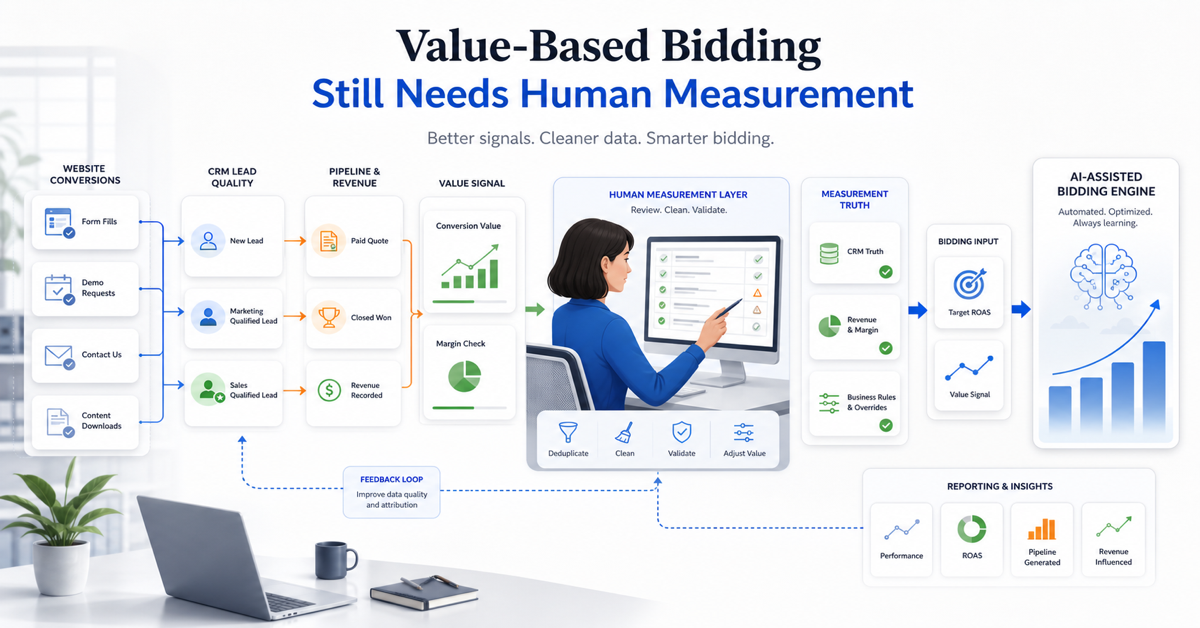
The human job is to define value, separate primary and secondary conversion actions, import offline quality where possible, use conversion value rules carefully, monitor lag and lead quality, and compare platform-reported value with CRM or revenue truth.
That is the measurement layer under value-based bidding.
Without it, Target ROAS and Maximize Conversion Value can still optimize. They may simply optimize toward the wrong version of success.
Here is the simple lead-generation version.
You do not need to feed every stage into bidding on day one. But the further your signal moves from "someone filled out a form" toward "this became paid legal work", the more useful value-based bidding becomes. I will come back to the actual formula in Check 2: Conversion Values Are Differentiated and the offline import workflow in Check 3: Lead Quality Or Offline Sales Can Be Imported Where Possible.
What Value-Based Bidding Actually Optimizes Toward
Google describes value-based bidding as a form of Smart Bidding that lets advertisers optimize campaigns based on the value brought to the business, not only the number of conversions.
That distinction matters.
Conversion-volume bidding asks the platform to find more conversions. Value-based bidding asks the platform to find more valuable conversions. If you need the broader bidding-strategy decision tree first, start with what's the best PPC bidding strategy, then come back to the measurement layer here.
In Google Ads, this usually means using:
- Maximize Conversion Value without a Target ROAS.
- Maximize Conversion Value with a Target ROAS.
- Conversion values assigned to actions or transactions.
- Conversion value rules that adjust value for specific conditions.
- Imported offline conversions or lead-stage values where relevant.
This is useful because two conversions can look identical in the ad account and be completely different in the business.
A demo request from a qualified B2B buyer is not the same as a student asking for free advice.
For a Lawpath-style legal service, a user who submits a quote request but never answers the service team is not the same as a user who accepts a paid legal quote two days later.
The rough daily-life formula is:
Estimated lead value = qualification rate x quote acceptance rate x average paid quote value x margin or LTV adjustment
If 100 legal quote requests produce 40 service-qualified leads, 12 accepted paid quotes, and an average paid quote value of $1,500, the starting value per raw form submission is:
12 / 100 x $1,500 = $180 estimated value per lead before margin or LTV adjustment
That value can be sent with the website conversion through Google Tag Manager when the form submission happens, using a unique transaction_id or lead ID. Later, when CRM or service-team data confirms the lead was unqualified, qualified, quoted, or paid, you can restate or retract the value using conversion adjustments. I will show the more practical version in Check 2: Conversion Values Are Differentiated.
Value-based bidding gives the platform a better target than raw volume. But it still relies on the values you provide.
That is where many accounts get into trouble.
The Problem Is Not The Bidding Strategy. It Is The Value Signal.
Most teams do not fail at value-based bidding because they chose the wrong button.
They fail because the account is teaching the bidding system a weak definition of value.
For ecommerce, value can be cleaner because the transaction has revenue attached. Even then, there are complications: refunds, margin, discounts, repeat purchase value, stock availability, new versus returning customer mix, and product category priority.
For lead generation, the mess is usually bigger.
A form fill is not a sale.
A phone call is not always qualified.
A booked meeting is not always an opportunity.
A lead from a low-intent content page should not always carry the same value as a high-intent pricing or service enquiry.
If every lead is worth $100 in Google Ads because someone needed a number, the bidding system will believe that number. It will not pause and ask whether the lead became revenue.
The next move is not just complaining about bad leads. Use conversion adjustments to restate or retract conversions when the CRM or service team proves the original value was wrong.
For a Lawpath-style quote flow, that might mean:
Important tracking note: conversion adjustments need a reliable identifier. For online conversions, Google says you can only adjust them if you used a transaction ID with the transaction. In practice, your form submission needs an order ID, transaction ID, or unique lead identifier passed when the conversion fires. Google Ads uses that ID with the conversion action name to find the conversion you want to adjust. If there is no order ID, some offline adjustment workflows may rely on GCLID and conversion time, but the cleanest setup is still: capture GCLID plus a stable lead/order ID from the start.
This is why I would link the measurement discussion back to the foundation: if you need the broader mechanics, start with value-based bidding in Google Ads. This article is about the layer underneath it.
The question is not only:
Can Google Ads optimize toward value?
The better question is:
Is the value signal accurate enough to deserve bidding power?
The Measurement Layer Under Value-Based Bidding
Before trusting a value-based bidding setup, I would audit the measurement layer in five parts.

This table is the difference between "we use value-based bidding" and "we have a value-based bidding system."
The first is a campaign setting.
The second is a measurement discipline.
Check 1: Primary Conversions Are Genuinely Primary
In Google Ads, primary conversion actions can be used for bidding. Secondary actions are still useful for observation and reporting, but they should not necessarily steer bidding.
That distinction is not cosmetic.
If a low-intent event is primary, the campaign can optimize toward it.
Common examples:
- Newsletter signups treated like sales leads.
- Contact forms counted without spam filtering.
- Calls counted without call duration or quality review.
- Page views or engagement events imported as bidding signals.
- GA4 events imported into Google Ads without deciding whether they deserve optimization weight.
GA4 now distinguishes between key events and conversions in a more specific way. In plain English: a key event is important behavior in Analytics, while a conversion is the action you use to measure and optimize ad performance.
That is useful language.
Not every key event should become a Google Ads conversion.
Not every Google Ads conversion should be primary.
Special note for custom goals: secondary does not always mean harmless. Google Ads' conversion-goals documentation includes this warning:
Important: If you include a secondary conversion action in a custom goal, it will be used for bidding when you set the custom goal in campaign settings.
So if you use custom goals, check the actual campaign goal configuration, not only the primary/secondary label on the conversion action.
Before touching Target ROAS, I would review every conversion action and ask:
- Would I pay more to get more of this exact action?
- Does sales agree this action has commercial value?
- Is this action deduplicated?
- Is it tracked from the right source?
- Should it be primary, secondary, or removed from bidding?
If that review feels boring, good. It is supposed to. A lot of expensive bidding mistakes hide in boring settings.
Check 2: Conversion Values Are Differentiated
Value-based bidding needs values.
That sounds obvious, but many accounts still use values that are too flat to be useful.
For ecommerce, that may mean passing transaction revenue. For more advanced accounts, it may mean thinking about profit margin, product category, new customer value, or lifetime value.
For lead generation, it usually means building an estimated value model.
The first version does not need to be perfect. It needs to be less lazy than treating every lead as equal.
A simple lead value model can start here:
Lead value = close rate x average revenue x margin adjustment
Example:
- 100 leads are generated.
- 20 become qualified.
- 5 become customers.
- Average customer revenue is
$4,000. - The lead-to-customer rate is 5%.
- Estimated lead value before margin adjustment is
$200.
That number is not the final truth. It is a working estimate.
For the Lawpath-style legal services example, the model can be slightly more operational:
Raw lead value = service-team qualification rate x paid quote acceptance rate x average paid quote value
If 100 quote requests produce 40 service-team qualified leads and 12 paid quotes at $1,500, the raw lead value is:
12 / 100 x $1,500 = $180
If margin or fulfilment capacity matters, adjust the value before feeding it into Google Ads:
Bidding value = raw lead value x margin adjustment
If the margin adjustment is 60%, the bidding value becomes:
$180 x 0.6 = $108
In Google Tag Manager, the first pass would usually be a conversion event with a stable lead/order ID and an estimated value:
dataLayer.push({
  event: 'generate_lead',
  transaction_id: 'lead_12345',
  value: 108,
  currency: 'AUD',
  service_type: 'legal_quote'
});
That does not mean the first value is final. It means the first value is traceable. Once the service team qualifies or rejects the lead, the CRM can use the same unique identifier to restate or retract the conversion value.
You can improve the model by segment:
Now the bidding system has a better signal.
It can still be wrong. But it is less wrong in a useful direction.
The danger is pretending the model is more precise than it is. I would label early values as estimates, review them monthly, and update them when CRM or sales data tells a different story.
Check 3: Lead Quality Or Offline Sales Can Be Imported Where Possible
For lead generation, the valuable event often happens after the website conversion.
The user submits a form today. Sales qualifies the lead tomorrow. The opportunity is created next week. Revenue may close in 30, 60, or 90 days.
If Google Ads only sees the form fill, it has an incomplete picture.
This is why offline conversion imports and enhanced conversions for leads matter. Google describes enhanced conversions for leads as an upgraded version of offline conversion import that can use user-provided data to improve matching between offline outcomes and ad interactions.
The practical point is simple: if you can feed better downstream outcomes back into the ad system, the bidding system has a better chance of learning what quality looks like.
Useful imported stages might include:
- Marketing-qualified lead.
- Sales-qualified lead.
- Opportunity created.
- Proposal sent.
- Closed won.
- Revenue or pipeline value.
You do not always need every stage. You need enough of a signal to stop treating junk leads and valuable opportunities as the same thing.
For the Lawpath-style legal services example, the useful action is not just "form submitted." The useful action might be "service team-qualified legal quote request" or "paid quote accepted." If you cannot import those later stages yet, at least report them beside Google Ads performance so the team can see whether the campaign is creating real legal-service demand or just cheap quote forms.
There is a privacy and consent layer here too. Do this properly. Capture the right data, hash user-provided data where required, respect consent requirements, and document the pipeline.
The operational question is:
Can the ad platform learn from what happened after the first conversion?
If not, your bidding system may be stuck optimizing toward the easiest action, not the best customer.
Salesforce integration note: many teams use the native Salesforce and Google Ads integration, which can be useful for importing milestones like opportunities. The limitation is that it may not give you the clean segmentation you want by service name, product line, or custom opportunity attributes. For example, if Service A and Service B both become won opportunities, you may not be able to import them as separate conversion actions just by filtering opportunity names or attributes inside the native setup. If that distinction matters for bidding, plan the conversion architecture before relying on the native import.
Check 4: Conversion Lag Is Understood Before Judging Performance
Value-based bidding can look worse or better than reality if you ignore lag.
Some value appears immediately. Ecommerce revenue may be reported quickly. A simple lead form may appear the same day.
But qualified pipeline and closed revenue often arrive later.
That means a campaign can look weak too early, then improve as delayed conversions and values arrive. It can also look good on shallow early signals, then disappoint once lead quality is reviewed.
Before judging a value-based bidding test, I would check:
- How long it takes for leads to become qualified.
- How long sales usually takes to close.
- Whether offline imports arrive daily, weekly, or manually.
- Whether the conversion window matches the buying cycle.
- Whether recent campaign changes are being judged before value has fully populated.
- The difference between the standard
Conversionscolumn andConversions (by conv. time). - The difference between
Conv. valueandConv. value (by conv. time).
This is especially important when a business moves from Target CPA or Maximize Conversions into Maximize Conversion Value or Target ROAS.
The reporting rhythm has to change.
The standard conversion columns are usually attributed back to the ad click date. The "by conversion time" columns show conversions based on when the conversion actually happened. For lead generation, that difference can be revealing.
If a legal quote request came from a click on 1 May but became a paid quote on 20 May, the standard column helps you understand which ad click earned credit. The conversion-time column helps you reconcile what happened in the business during the reporting period.
If sales value takes 45 days to appear, a three-day verdict is not analysis. It is impatience wearing a dashboard costume.
Check 5: CRM And Revenue Reporting Can Challenge Google Ads
Google Ads is not the whole truth.
It is a platform view of performance. A useful one, but still a platform view.
The business needs a second lens.
At minimum, I would want reporting that connects:
The dashboard should make one thing obvious:
Are we growing valuable demand, or just reporting more tracked activity?
If Google Ads says conversion value is up 40%, but CRM-qualified opportunities are flat, I would not celebrate yet.
I would ask:
- Did cheaper leads inflate the value column?
- Did value rules overstate a segment?
- Did a soft action become primary?
- Did a new landing page attract more low-quality enquiries?
- Are automated campaigns sending quote-ready legal-service traffic to a commercial page, or are they leaning on broad blog posts that create cheap but unqualified forms?
- Did sales qualification criteria change?
- Is there enough lag for downstream value to appear?
This is what I mean by landing page mix. Do not only ask which pages got conversions. Ask which pages produced qualified value. A blog post, service page, comparison page, quote page, and homepage can all generate forms, but they may create very different lead quality. If automation starts routing more traffic to a page because it creates cheap form fills, the CRM needs to tell you whether those forms became qualified leads or paid quotes.
For Salesforce specifically, this is where the native integration limitation matters. If the import treats multiple won opportunity types as one conversion action, your dashboard still needs a separate CRM view by service line, opportunity type, landing page, and campaign. Otherwise "won opportunity" can hide the difference between Service A, Service B, and quote-based legal work that should carry different values.
That is the human measurement layer doing its job.
Where Conversion Value Rules Help And Where They Can Mislead
Conversion value rules let advertisers adjust conversion values based on factors such as location, device, and audience conditions. Google notes that these adjusted values can be used in value-based bidding strategies, including Target ROAS and Maximize Conversion Value.
That can be powerful.
For example:
- Leads from one region may close at a higher rate.
- Existing customers may have a different value than new users.
- Mobile enquiries may be less valuable for one business and more valuable for another.
- High-income or high-intent audience segments may justify a value adjustment if the data supports it.
The phrase doing the work there is: if the data supports it.
Value rules are not a place to store hunches.
Bad use of value rules:
- "Sydney leads feel better, so double them."
- "Mobile traffic looks messy, so halve it."
- "Returning users must be more valuable, so increase them by 50%."
Better use of value rules:
- CRM shows leads from a specific region close at twice the rate and similar revenue.
- Repeat buyers have materially higher lifetime value.
- A certain audience segment consistently produces higher-margin customers.
- Device-level differences are stable across enough data and not caused by a broken landing page.
The risk is that value rules can make the reporting look cleaner while encoding the wrong assumption into bidding.
Use them, but make them earn their place.
Target ROAS Is A Constraint, Not A Personality Test
Target ROAS often becomes emotional.
Someone wants a high ROAS because it sounds disciplined. Someone else wants growth and sees ROAS targets as handcuffs.
Both can be right in different contexts.
Google's Target ROAS bidding tries to maximize conversion value while aiming for an average return on ad spend target. That can be useful when the account has enough conversion value data and the business has a real efficiency constraint.
But Target ROAS is not automatically better than Maximize Conversion Value without a target.
This is why I usually treat bidding strategy as a campaign-stage decision. A new campaign, a learning campaign, and a mature campaign do not need the same constraint. If you want the broader framework, I covered this in how to choose the right bidding strategy in every campaign stage.
Before using or tightening Target ROAS, I would ask:
- Are conversion values reliable?
- Does the campaign have enough recent conversion value data?
- Is the budget constrained or uncapped?
- Is the goal efficiency, growth, or learning?
- Are we using actual revenue, estimated value, or rough proxy values?
- Will the target restrict volume before the system has enough clean data?
A too-aggressive Target ROAS can starve a campaign.
A too-loose target can let the campaign chase weak value.
The target is only as useful as the value signal and the business goal behind it.
Google's value-based bidding best-practice guidance also gives a useful floor: choose a lead-to-sale stage with a relatively short delay and at least 15 monthly conversions, upload data frequently, and avoid evaluating too early. In my own campaign-stage rule of thumb, I would rather see roughly 30 conversions in 30 days before I feel confident setting a tighter campaign-level Target ROAS, especially for lead generation.
Common Failure Modes
Most value-based bidding problems are not mysterious.
They usually fit one of these patterns.
This is the part that connects back to broader paid search automation.
In my AI Max search control article, the core point was that automation does not remove control. It moves control upstream.
Value-based bidding is the same pattern.
The control is not only in the bid strategy dropdown. It is in the conversion actions, values, imports, page mix, sales feedback, and reporting discipline around the campaign.
A 30-Day Measurement Cleanup Plan
If I had to clean up a value-based bidding account in 30 days, I would not start by changing every campaign at once.
I would clean the signal first.
Week 1: Audit Conversion Actions
Review every conversion action in Google Ads and GA4.
For each one, decide:
- What action does this represent?
- Is it tracked accurately?
- Is it duplicated?
- Is it primary or secondary?
- Does the business actually want more of it?
- Is it suitable for bidding?
By the end of week one, the account should have fewer vague bidding signals.
That alone can improve decision quality.
Week 2: Build First-Pass Value Estimates
Create value estimates for the main actions.
For ecommerce, review revenue, refunds, margin, product groups, and new customer value.
For lead generation, use close rate, average revenue, and margin-adjusted estimates.
Start simple:
Do not pretend the model is finished. Make it visible, document assumptions, and schedule a review.
Week 3: Connect Offline Quality Where Possible
If the business has a CRM, this is the week to connect ad performance to lead quality.
The goal is not to build a perfect attribution temple. The goal is to stop flying blind.
Useful outputs:
- Lead source and campaign captured in CRM.
- GCLID or user-provided data captured where appropriate.
- Qualified lead stages mapped.
- Closed-won revenue mapped.
- Offline import process documented.
- Sales feedback loop scheduled.
Even if imports are not ready yet, a manual weekly comparison between Google Ads leads and CRM quality is better than ignoring the question.
Week 4: Review Bidding And Reporting After The Signal Is Cleaner
Only after the signal is cleaner would I revisit the bidding strategy.
Questions to ask:
- Should the campaign use Maximize Conversion Value without a target first?
- Is Target ROAS appropriate yet?
- Are value rules justified?
- Are some campaigns still better suited to Target CPA or Maximize Conversions?
- Do automated campaign types like Performance Max have enough clean value and asset inputs?
- Are landing pages attracting the right type of enquiry?
This is also where creative and page quality matter.
If the ad copy attracts the wrong people, the value signal has to work harder. If the landing page is vague, the form fills may look cheap but qualify poorly. Before handing more control to automation, revisit whether the offer, page, and Google Ads copy are attracting the right demand.
The Human Measurement Questions I Would Keep Asking
These are the questions I would put into the recurring reporting rhythm:
- Which conversion actions are currently primary?
- Which values are actual, estimated, or rule-adjusted?
- Which lead stages are being imported back into Google Ads?
- Which campaigns generate the highest qualified lead rate?
- Which campaigns generate the most reported value but weak CRM quality?
- Which landing pages create valuable demand?
- Which search term themes are expanding into poor-fit enquiries?
- Which value rules are still supported by evidence?
- How long does value take to appear after the first click?
- What would we change if we trusted CRM revenue more than platform ROAS?
That last question is the useful one.
It forces the team to admit whether the account is being optimized for reported performance or business performance.
This is also where the conversation gets bigger than Google Ads. A good measurement system helps paid media, SEO, CRO, sales, and finance argue from the same reality. That is the same discipline needed when measuring brand vs performance marketing: the metric has to match the decision you are trying to make.
My Take
Automation is not the enemy.
Bad measurement is.
Value-based bidding is a good idea when the business can explain what value means. It is a dangerous idea when the account simply gives every tracked action a number and hopes the machine sorts out the rest.
The future of paid search is going to include more automation, not less. That does not make the marketer less important. It changes the marketer's job.
The useful work moves upstream:
- Define which actions deserve bidding power.
- Assign values that reflect commercial reality.
- Import offline quality where possible.
- Use value rules carefully.
- Check conversion lag before making decisions.
- Compare platform value with CRM and revenue truth.
If the signal is clean, value-based bidding can help the account find better demand.
If the signal is messy, it will just optimize the mess with more confidence.
That is why value-based bidding still needs human measurement.
Need A Second Pair Of Eyes On Your Measurement Setup?
If your Google Ads account is moving deeper into Smart Bidding, Target ROAS, Performance Max, or AI-assisted campaign management, the measurement layer matters more than ever.
I work across paid media, SEO, analytics, and growth systems, which is usually where these problems actually live. If you want a practical review of your conversion actions, value model, offline imports, or reporting layer, get in touch through DEANLONG.io.
Sources
- Google Ads and Commerce: 2026 digital advertising and commerce AI updates
- Google Ads Help: About Smart Bidding using value-based bidding for Search
- Google Ads Help: Value-based bidding best practices
- Google Ads Help: About conversion values
- Google Ads Help: About conversion value rules
- Google Ads Help: About Target ROAS bidding
- Google Ads Help: About Smart Bidding
- Google Ads Help: About enhanced conversions for leads
- Google Ads Help: About conversion adjustments
- Google Ads Help: About conversion goals
- Google Ads Help: Understand your conversion tracking data
- Google Analytics Help: GA4 release notes
- Google Analytics Help: GA4 conversions vs key events
- Lawpath: Pricing & plans
- Lawpath Legal: Online law firm for small businesses